In an effort to be more green, I have started collecting artworks that inspire me and reference images for working projects here instead of pasting them in sketchbooks. I find that this blog is easier for me to access as a working artist, and it keeps my ideas organized. I hope you'll enjoy these images as much as I do! ~Savanna Leigh
I do not own these images, they belong to the artists and photographers named therein.
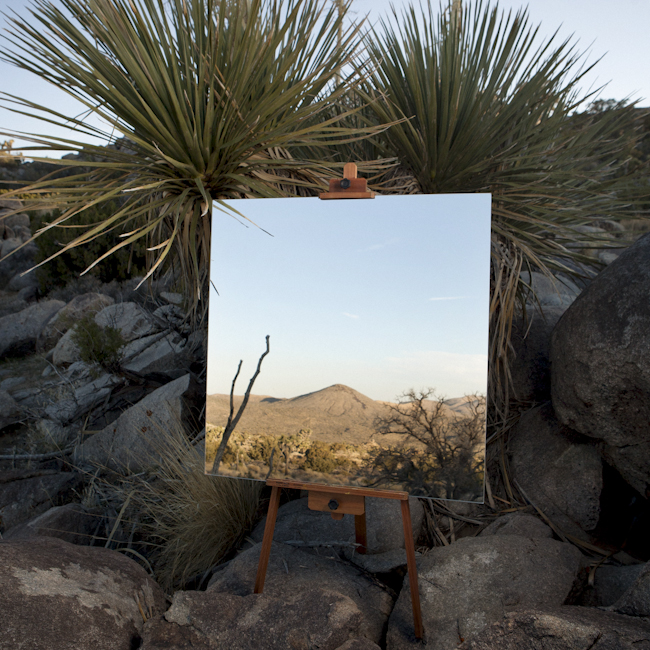
"In March of 2012, I was awarded an artist's residency by the United States National Park Service in southern California’s Joshua Tree National Park. While staying in the Park, I spent much of my time visiting the borderlands of the park and the areas where the low Sonoran desert meets the high Mojave desert. While hiking and driving, I caught glimpses of the border space created by the meeting of distinct ecosystems in juxtaposition, referred to as the Edge Effect in the ecological sciences. To document this unique confluence of terrains, I hiked out a large mirror and painter’s easel into the wilderness and captured opposing elements within the environment. Using a single visual plane, this series of images unifies the play of temporal phenomena, contrasts of color and texture, and natural interactions of the environment itself."
Glacial Rebound
As contentious debate on the impact of global warming drives on, something unique is occurring in the coastal areas of Alaska. Rather than rising sea levels and diminishing coastlines, the land in southeast Alaska is rising out of the ocean at an accelerated rate. This phenomenon is known as post-glacial rebound or isostatic adjustment, and is a direct result of global warming. The region was once covered by vast glaciers and ice fields, which massively deformed and submerged the coastal landscape. As global temperatures rise, the weight of glacial ice is rapidly melting away, and previously buried land is bursting forth into view.
This series is composed of photographs of the extant Alaskan landscape paired with photo-sculptural pieces representing the nascent landscapes to come. The photo-sculptural pieces were created through manipulating silver gelatin emulsion paper and sculpting it into rough approximations of the existing underwater topography. Dry chemistry was then applied directly to the emulsion and washed over with water; as the water flows around ridges and through valleys, it simulates trails and pools that are reminiscent of glaciers, glacial melt waters, silt deposits and the new risen muddy tidal flats.
This project serves as a reminder that the world often fails to conform to our polarized understanding of human-environmental interaction. As political battles rage over the possibility of coastal inundation, these pieces speak to the complexity of the natural world. The contrast of the potential topographies of the future with the natural landscapes of the present challenges the simplified arguments on both sides of the climate change debate. The pieces seek to expand the discourse, while grounding it in the concrete and complex reality of our Earth.
An interesting blend of design, sculpture, performance art, video, and music
...not to mention gender!
Check out Sputniko's website for more projects like the "Sushiborg Yukari" which is a bizzare mix of Tarentino and Nyotai Mori, and the "Penis Cybernetique" which responds to your heartrate, allowing women to grow a boner. Very cool designer.
It’s 2010, so why are humans still menstruating?’
"As a female designer I had one big question I wanted to solve.
The pill free, bleeding interval was devised when the contraceptive pill first came out, only because it was felt by doctors that women would find having no periods too unacceptable (since the 1960s, taking the pill continuously could have removed periods all together) The doctors may think that women are psychologically attached to their periods, but only humans, apes and bats out of all mammals need to bleed monthly for their reproductive cycle. What does Menstruation mean, biologically, culturally and historically, to humans? Who might choose to have it, and how might they have it?
Fitted with a blood dispensing mechanism and lower-abdomen-stimulating electrodes, the Menstruation Machine is a device which simulates the pain and bleeding of an average 5 day menstruation process of a human (well…I have done my best to simulate my own, at least).
The machine is not worn only by men, but also by women when menstruation may become obsolete in the future and the process becomes a mere ritual of gender and identity. The music video illustrates just one example of many possibilities of how and by whom this machine can be used."
Rarely am I ever truely moved by photography. Even more seldom am I moved by landscape photography. Coffee table/calendar/Ansel Adams stuff always just breezes past me.
But this. THIS.
Burtynsky has completely electrified me. I cannot devour these images enough. Someone PLEASE buy me his books!!!
Jump was born in 1952, Halsman said, after an arduous session photographing the Ford automobile family to celebrate the company’s 50th anniversary. As he relaxed with a drink offered by Mrs. Edsel Ford, the photographer was shocked to hear himself asking one of the grandest of Grosse Pointe’s grande dames if she would jump for his camera. “With my high heels?” she asked. But she gave it a try, unshod—after which her daughter-in-law, Mrs. Henry Ford II, wanted to jump too.
For the next six years, Halsman ended his portrait sessions by asking sitters to jump. It is a tribute to his powers of persuasion that Richard Nixon, the Duke and Duchess of Windsor, Judge Learned Hand (in his mid-80s at the time) and other figures not known for spontaneity could be talked into rising to the challenge of…well, rising to the challenge. He called the resulting pictures his hobby, and in Philippe Halsman’s Jump Book, a collection published in 1959, he claimed in the mock-academic text that they were studies in “jumpology.”
Portraiture is one of the greatest challenges in photography, because the human face is elusive and often mask-like, with practiced expressions for the standard range of emotions. Some photographers accept these preset expressions—think of annual-report portraits of corporate officers—and others try to eliminate expression altogether, to get a picture as neutral as a wanted poster. Halsman was determined to show his sitters with their masks off but their true selves in place.