http://www.conradjgodly.com/
Showing posts with label Landscape. Show all posts
The Edge Effect
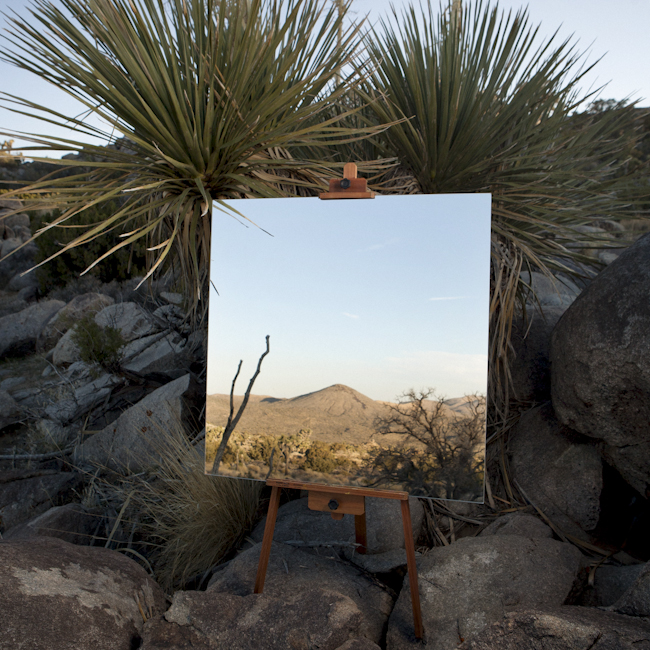
"In March of 2012, I was awarded an artist's residency by the United States National Park Service in southern California’s Joshua Tree National Park. While staying in the Park, I spent much of my time visiting the borderlands of the park and the areas where the low Sonoran desert meets the high Mojave desert. While hiking and driving, I caught glimpses of the border space created by the meeting of distinct ecosystems in juxtaposition, referred to as the Edge Effect in the ecological sciences. To document this unique confluence of terrains, I hiked out a large mirror and painter’s easel into the wilderness and captured opposing elements within the environment. Using a single visual plane, this series of images unifies the play of temporal phenomena, contrasts of color and texture, and natural interactions of the environment itself."
Glacial Rebound
As contentious debate on the impact of global warming drives on, something unique is occurring in the coastal areas of Alaska. Rather than rising sea levels and diminishing coastlines, the land in southeast Alaska is rising out of the ocean at an accelerated rate. This phenomenon is known as post-glacial rebound or isostatic adjustment, and is a direct result of global warming. The region was once covered by vast glaciers and ice fields, which massively deformed and submerged the coastal landscape. As global temperatures rise, the weight of glacial ice is rapidly melting away, and previously buried land is bursting forth into view.
This series is composed of photographs of the extant Alaskan landscape paired with photo-sculptural pieces representing the nascent landscapes to come. The photo-sculptural pieces were created through manipulating silver gelatin emulsion paper and sculpting it into rough approximations of the existing underwater topography. Dry chemistry was then applied directly to the emulsion and washed over with water; as the water flows around ridges and through valleys, it simulates trails and pools that are reminiscent of glaciers, glacial melt waters, silt deposits and the new risen muddy tidal flats.
This project serves as a reminder that the world often fails to conform to our polarized understanding of human-environmental interaction. As political battles rage over the possibility of coastal inundation, these pieces speak to the complexity of the natural world. The contrast of the potential topographies of the future with the natural landscapes of the present challenges the simplified arguments on both sides of the climate change debate. The pieces seek to expand the discourse, while grounding it in the concrete and complex reality of our Earth.
This series is composed of photographs of the extant Alaskan landscape paired with photo-sculptural pieces representing the nascent landscapes to come. The photo-sculptural pieces were created through manipulating silver gelatin emulsion paper and sculpting it into rough approximations of the existing underwater topography. Dry chemistry was then applied directly to the emulsion and washed over with water; as the water flows around ridges and through valleys, it simulates trails and pools that are reminiscent of glaciers, glacial melt waters, silt deposits and the new risen muddy tidal flats.
This project serves as a reminder that the world often fails to conform to our polarized understanding of human-environmental interaction. As political battles rage over the possibility of coastal inundation, these pieces speak to the complexity of the natural world. The contrast of the potential topographies of the future with the natural landscapes of the present challenges the simplified arguments on both sides of the climate change debate. The pieces seek to expand the discourse, while grounding it in the concrete and complex reality of our Earth.
Source: http://www.architizer.com/en_us/blog/dyn/28058/a-negative-garden-of-eden/
Belgian artist Kris Verdonck presents some of the strongest work I've seen in a while- maybe I find it compelling because of its marriage of installation art and ecology- but then, I've always been a fan of immersing the viewer in a challenging environment.
Verdonck filled a gallery space with Belgian's most notorious invasive species (non-native species which flourish under alien conditions, killing off the native biodiversity. Think Maryland's snakehead fish or bamboo problems.) Flora and fauna include grasses, trees, birds, amphibians, and other species.
From Architizer:
Visitors were invited to put on protective suits and traipse through the garden, hyper aware that even the smallest seed or animal cannot be allowed to escape the premises. Drastically changed by its contents, the first floor of the gallery suddenly became a space of quarantine, defined by its duty to enclose and keep out. The protective clothing and the eventual complete destruction of the installation were both crucial to the work as a whole.
Like many of Verdonck’s other installations, EXOTE is a critical reflection on the current state of the world. The artist magnifies our current environmental problems and ecological disasters with a Kafka-esque metaphor, constructing a sealed microcosm of a world that is shaped by man and slowly becoming uninhabitable. Verdonck’s installation turned a bare contemporary art space into an apocalyptic landscape.
Belgian artist Kris Verdonck presents some of the strongest work I've seen in a while- maybe I find it compelling because of its marriage of installation art and ecology- but then, I've always been a fan of immersing the viewer in a challenging environment.
Verdonck filled a gallery space with Belgian's most notorious invasive species (non-native species which flourish under alien conditions, killing off the native biodiversity. Think Maryland's snakehead fish or bamboo problems.) Flora and fauna include grasses, trees, birds, amphibians, and other species.
From Architizer:
Visitors were invited to put on protective suits and traipse through the garden, hyper aware that even the smallest seed or animal cannot be allowed to escape the premises. Drastically changed by its contents, the first floor of the gallery suddenly became a space of quarantine, defined by its duty to enclose and keep out. The protective clothing and the eventual complete destruction of the installation were both crucial to the work as a whole.
Like many of Verdonck’s other installations, EXOTE is a critical reflection on the current state of the world. The artist magnifies our current environmental problems and ecological disasters with a Kafka-esque metaphor, constructing a sealed microcosm of a world that is shaped by man and slowly becoming uninhabitable. Verdonck’s installation turned a bare contemporary art space into an apocalyptic landscape.
Subscribe to:
Posts (Atom)